

Updated

If you have been researching facial volume loss, you have probably run into two very different answers: filler and Sculptra.
They are not the same thing, and confusing them is the fastest way to be disappointed with your results. So let’s answer the real question directly — what is Sculptra, and why do doctors treat it as a category of its own?
Quick Answer (TL;DR): Sculptra is an injectable collagen stimulator made of poly-L-lactic acid (PLLA). Unlike a traditional filler, it does not add instant volume — instead it prompts your own skin to gradually build new collagen over roughly 2–3 months.
Results are subtle and build slowly, which is exactly why timeline management matters. It is well suited to widespread, structural volume loss, but it is not reversible the way hyaluronic acid filler is. In Korea it is typically priced per vial, and suitability is decided in consultation — not everyone is a candidate.
Hello, and thank you for reading. I’m writing on behalf of the medical team at Aive Clinic Seoul, where Representative Director Dr. Park is an officially designated Key Doctor for Olidia — a PLLA-based collagen stimulator in the same family as Sculptra.
Because we work with these biostimulators clinically, our goal here is a straight, honest explanation rather than a sales pitch.
What Is Sculptra, Exactly?
Bottom line: Sculptra is a biostimulator, not a space-filler. Its active ingredient is poly-L-lactic acid (PLLA) — a synthetic, biocompatible material that has been used for decades to make absorbable surgical sutures.
When injected, the tiny PLLA microparticles act as a gentle, controlled stimulus to your fibroblasts — the skin cells responsible for producing collagen. Surgeons often describe PLLA as “fertilizer for fibroblasts.”
Over several months, your body gradually breaks the particles down and clears them, leaving behind newly formed collagen of your own.
That single mechanism explains almost everything people find confusing about it. Because the volume is your own tissue built over time, the look tends to be gradual and structural rather than an instant plump.
It also means the effect is not reversible: hyaluronic acid filler can be dissolved with an enzyme (hyaluronidase), but there is no chemical “undo” once PLLA has triggered collagen. This is why careful, conservative dosing by a licensed doctor matters so much.
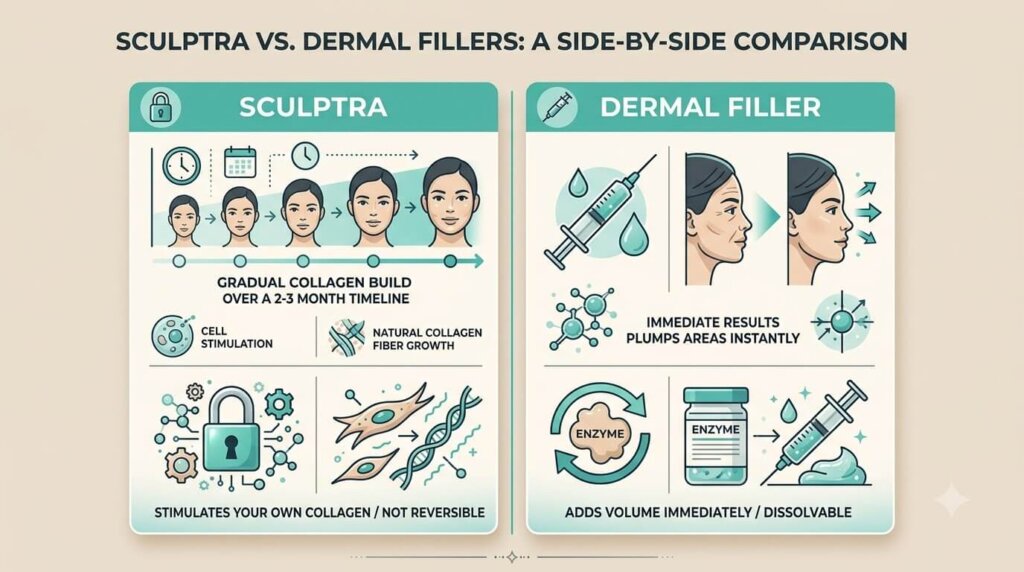
Is Sculptra a Filler? How It Differs From Dermal Filler
Short answer: no — and treating it like one is the most common mistake. A traditional dermal filler (Juvéderm, Restylane, and similar HA gels) physically occupies space and draws in water to expand the treated area immediately. You see the change the day of treatment.
Sculptra works on a different clock and toward a different goal. Here is how the two compare on the points patients actually ask about.
| Feature | Sculptra (PLLA biostimulator) | Dermal filler (HA) |
|---|---|---|
| How it works | Stimulates your own collagen | Physically adds volume |
| When you see results | Gradual, over ~2–3 months | Immediate |
| Look | Subtle, structural, natural build | Instant plumping of a specific area |
| Reversible? | Generally not reversible | Can be dissolved (hyaluronidase) |
| Best for | Widespread, diffuse volume loss | Targeted contouring (lips, nose, tear trough) |
| Sessions | Often a short series, spaced weeks apart | Frequently a single session |
If your concern is a defined area — lips, a low bridge, or under-eye hollows — a targeted HA filler is usually the more appropriate tool. If you want to understand how long those results tend to hold, our guide on how long dermal fillers last by face area breaks it down realistically.
For sudden facial gauntness after significant weight change, our overview of fillers for “Ozempic face” covers when instant volume is the better fit.
For a side-by-side decision framework specific to Korean clinics, see our dedicated comparison: Sculptra vs Dermal Filler — Which Is Right for You?
And if you are weighing early-stage skin quality treatments against volume, tear trough filler in Seoul is a useful contrast case for a targeted area.
First visit to Aive?
Planning Botox or filler in Seoul?
🎁 First-visit bonus: a $100 post-treatment LED & hydration session, included with your first treatment.
What are you considering?
When are you in Seoul?
Answered in English. Prefer a form? Send us a note below ↓
How Sculptra Works: The 2–3 Month Timeline You Must Manage
Bottom line: patience is part of the treatment plan. Managing expectations around the timeline is arguably the single most important factor in patient satisfaction with Sculptra.
- Day of treatment: Some temporary swelling from the injection fluid can make you look fuller — but this is water, not your final result, and it settles within days.
- Weeks 1–4: The apparent “volume” fades as swelling resolves. Many patients feel like nothing happened. This is normal and expected.
- Months 2–3+: New collagen gradually forms, and the structural, natural-looking improvement appears. Results in many cases continue to develop with each session.
Because the change is slow, Sculptra is usually given as a short series of sessions spaced several weeks apart, so your doctor can build gradually and reassess.
Individual results vary, and the number of vials and sessions depends entirely on your degree of volume loss.
Who Is a Good Candidate — and Who Isn’t
Bottom line: Sculptra rewards diffuse volume loss, not spot correction. It was originally developed to treat significant facial fat loss and is now widely used cosmetically for widespread, structural volume loss.
Often a good fit
- Hollow temples, flattening cheeks, and a softening jawline from age-related volume loss
- Naturally lean faces, endurance athletes, or anyone who looks gaunt as facial fat decreases
- People who prefer a gradual, natural build over an obvious, immediate change
Often not the right tool
- Anyone wanting an instant result for an event next week
- Very localized concerns better served by targeted filler (lips, precise nose shaping)
- People uncomfortable with a treatment that cannot be easily reversed
This is exactly why a consultation matters — not everyone is a candidate, and honest suitability screening protects your result.
If you are also considering lifting on top of volume, our note on combining lifting and volume treatments explains how these are sequenced.
The Downsides: Why Some Doctors Are Cautious About Sculptra
Bottom line: the honest limitations are timeline, technique-dependence, and irreversibility. A well-informed patient should hear these before booking.
- Slow, invisible early phase: Patients expecting an instant result can feel let down in the first month before collagen forms.
- Not easily reversible: Unlike HA filler, there is no enzyme to dissolve it — so conservative dosing and correct placement are essential.
- Technique-sensitive: Proper reconstitution, injection depth, and even dose distribution reduce the risk of small nodules or unevenness. Side effects are uncommon and are explained beforehand.
- Multiple sessions: The need for a series means more visits and a longer overall plan than a one-off filler.
None of these make Sculptra a bad treatment — they simply mean it must be matched to the right patient by an experienced injector. That is where the clinic model genuinely matters.
The Aive Clinic Difference for Biostimulators
Because collagen stimulators are so technique-dependent, we structure care differently from high-volume, assembly-line clinics:
- Dr. Park performs the injections directly — no shadow doctors. With PLLA, the hand placing each pass matters.
- 1:1 VIP private room for your consultation and treatment, so mapping your volume loss is unhurried.
- 3-Stage Comfort System designed to keep discomfort well managed throughout the session.
- Honest candidacy screening — if filler or another approach suits you better, we will say so.
International patients also receive a first-visit Premium Astrodome session. Korea’s 10% VAT refund for cosmetic procedures ended on January 1, 2026, so international patients now pay the 10% VAT, and prices at Aive Clinic are listed before VAT.
How Much Does Sculptra Cost in Korea?
Bottom line: Sculptra in Korea is priced per vial, and the number of vials depends on your face.
Because it treats broad volume loss, a fuller correction may use more vials than a single, localized filler session — so a per-vial price alone doesn’t tell you your total.
Rather than quote a single figure that would be misleading, we give a personalized estimate at consultation based on how many vials and sessions your degree of volume loss actually requires.
Korea’s competitive aesthetic market and high procedure volume generally make structured biostimulator plans reasonably priced compared with many Western markets, but your quote should reflect your plan, not an advertised headline number.
Ask for a written breakdown before you commit.
Book Your Consultation — first visit includes a complimentary Premium Astrodome session
What is the downside of Sculptra?
The main downsides are its slow timeline (results build over about 2–3 months, with little visible change early on), the need for multiple sessions, and the fact that it is not easily reversible like hyaluronic acid filler. It is also technique-sensitive, so an experienced injector is important. Side effects are uncommon and are explained beforehand.
How much does Sculptra usually cost?
Sculptra is priced per vial, and the total depends on how many vials and sessions your degree of volume loss requires — so a single per-vial figure rarely reflects your real cost. At Aive Clinic Seoul we provide a personalized estimate at consultation. Individual plans and pricing vary.
Is Sculptra better than fillers?
Neither is universally better — they do different jobs. Sculptra suits gradual, widespread volume restoration by stimulating your own collagen, while dermal filler suits immediate, targeted contouring and can be dissolved if needed. The right choice depends on your goals, which a consultation determines.
Why do some plastic surgeons not recommend Sculptra?
Caution usually comes from three facts: the results are slow and invisible early, it is not easily reversible, and it is technique-dependent, so poor placement can cause unevenness. Many surgeons do use it successfully — they simply reserve it for the right candidates and inject conservatively.
Dr. Junhyung Park is an aesthetic physician leading Aive Clinic in Sinsa-dong, Gangnam, Seoul, specializing in non-surgical facial contouring, stem-cell anti-aging, and culturally customized treatments for international patients. He is a certified Key Doctor (QT-fill, Ollidia, Sinclair) and Academic Director of the Korean Clinical Aesthetic Medicine Society, and regularly lectures at medical conferences to train other physicians. A former US 8th Army medical interpreter, he supports patients in English, Japanese, and Chinese.
 Dr. Junhyung Park, founderAcademic Director, Korean Clinical Aesthetic Medicine Society★ 5.0 · 688 Google reviews📍 Sinsa Station Exit 8
Have a question? Get a personalized answer.
Tell us a little and our medical team replies within 24 hours — no obligation.
What patients say
“…a consultation with the doctor to actually review a full treatment plan that made sense for me, no pressure to choose to do more or upsell.”— Marisa G., Google review
“It’s foreigner-friendly, and I was able to get my consultation fully in English.”— Lia, Google review
“The consultation was thorough and honest, they really took the time to understand what I wanted and explained the procedures clearly without any pressure.”— Mi n, Google review
Visit us
📍 K-Tower 5F, 119 Dosan-daero, Gangnam-gu, Seoul · Sinsa Station (Line 3 / Shinbundang) Exit 8
🕐 Mon, Tue, Fri 10:00–20:00 · Wed, Thu 10:00–19:00 · Sat 10:00–16:00 · Closed Sun & public holidays
💬 Consultations in English · Directions →
Planning Botox or filler? Get a doctor’s plan before your trip.
Get my plan →